The Great Own Goal: How Trump’s Tariffs Financed Chinese Expansion and Punished Americans
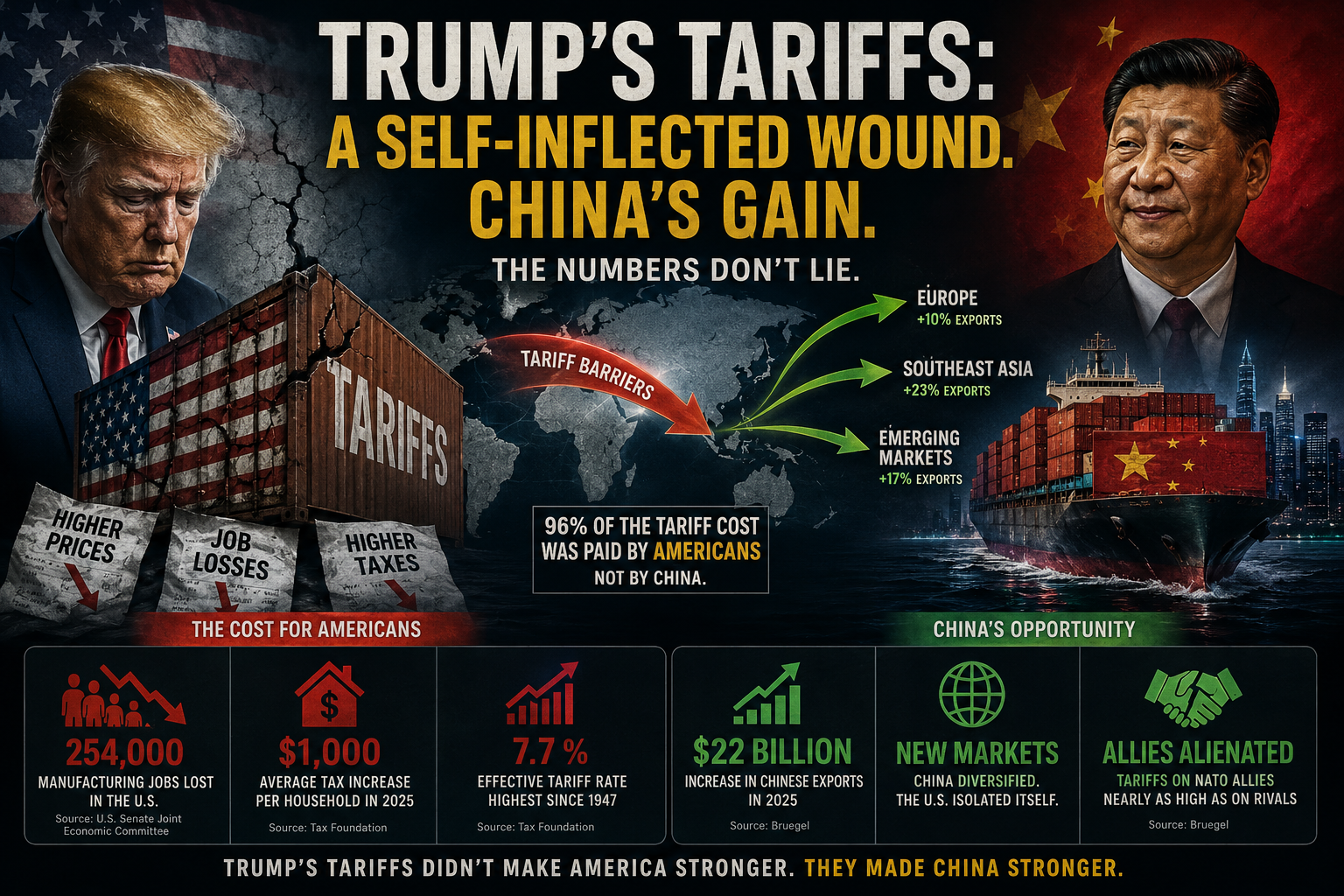
In the vast and complex arena of global geopolitics, few strategies have been so loudly announced and so spectacularly counterproductive as Donald Trump’s tariff war. Sold to the American public as a heroic crusade to protect domestic industry, punish China, and force allies to “pay their fair share,” the reality of the numbers reveals a very different narrative. What we witnessed was not an American industrial renaissance, but rather a formidable self-inflicted wound that cost U.S. consumers dearly, alienated historic partners, and, ironically, opened the doors of the global market to Chinese expansion.
The Great Illusion: Who Really Pays the Tariffs?
The central premise of Trump’s trade policy was seductive in its simplicity: imposing heavy tariffs on imports would force foreign countries to foot the bill, while American factories would roar back to life. Yet the global economy does not operate according to the rules of a reality television show. According to a forceful study by Germany’s Kiel Institute for the World Economy, the claim that foreigners pay the tariffs is an absolute myth. The data reveal that an astonishing 96% of the tariff burden was passed directly on to American buyers, while foreign exporters absorbed a mere 4%.
In other words, the Trump administration effectively implemented a massive consumption tax on its own citizens. As Julian Hinz, research director at the Kiel Institute, observed: “The claim that foreign countries pay these tariffs is a myth. The data show the opposite: Americans are footing the bill.”
The study analyzed more than 25 million shipping records, covering nearly four trillion dollars in U.S. imports. The findings are unequivocal: U.S. customs revenues increased by approximately $200 billion in 2025, but almost all of that amount came out of the pockets of American consumers and importers.
Domestic Economic Impacts: A Silent Disaster
The impacts of this policy on the domestic U.S. economy are difficult to ignore. The Tax Foundation estimates that, in 2025, Trump’s tariffs resulted in an average tax increase of $1,000 per American household, with the effective tariff rate reaching 7.7% — the highest level since 1947. For 2026, an additional increase of $700 per household is projected.
Far from bringing jobs back, the tariff policy contributed to the loss of approximately 254,000 jobs, particularly in the manufacturing sector, which was supposedly meant to be the great beneficiary. A report by the U.S. Senate Joint Economic Committee documented that during Trump’s first year, the manufacturing industry lost 108,000 jobs, directly contradicting the promises of an industrial renaissance.
In addition, the Federal Reserve Bank of St. Louis noted that tariffs accounted for 0.5 percentage points of annualized PCE inflation between June and August 2025, placing further pressure on Americans’ cost of living. Durable goods such as furniture, vehicles, and electronics experienced particularly sharp price increases, with tariff pass-through reaching approximately 35% by August 2025.
The Strategic Failure: The Trade Deficit Increased
Perhaps the most glaring failure of Trump’s tariff policy is its failure to achieve its stated objective: reducing the U.S. trade deficit. Tax Foundation data show that the goods trade deficit increased by $25.5 billion in 2025; it did not decrease. The overall decline in the trade deficit was only $2.1 billion, driven entirely by an increase in the services surplus, not by any improvement in goods trade relations.
Economically, this makes sense. As researchers at the Brookings Institution explain, a country’s trade deficit is not determined primarily by trade policy, but by the macroeconomic dynamics between domestic saving and investment. Tariffs do not fundamentally alter those dynamics; they merely redistribute costs.
Alienating Allies: When Strategy Meets Incompetence
Instead of consolidating a united front against strategic adversaries, the Trump administration chose to alienate crucial partners in Europe. The European think tank Bruegel estimates that the tariffs could cause a 0.3% contraction in the European Union’s GDP, with Germany, the bloc’s economic engine, facing a reduction of up to 0.4%.
The Kiel Institute projects that Germany could lose up to €30 billion in output over the long term as a result of these policies, with short-term losses estimated at €15 billion. Ireland, with its strong U.S.-oriented pharmaceutical industry, is particularly vulnerable, as is Italy, with its significant exposure in transport equipment and fashion.
By imposing tariffs on NATO allies at nearly the same level as those applied to the rest of the world, Washington not only weakened vital diplomatic ties, but also fragmented the Western alliance at a time of intensifying global competition. French President Emmanuel Macron, responding to Trump’s tariffs, stated that France “will adapt” and “will look precisely at the consequences,” signaling a troubling shift in Europe’s posture toward the United States.
The Geopolitical Paradox: How Trump Financed China’s Rise
And who was the great beneficiary of this fragmentation and misdirected protectionism? Precisely the main target of Trump’s rhetoric: China. While the United States isolated itself behind tariff walls, Beijing displayed remarkable strategic agility.
Confronted with barriers in the American market, China did not retreat; it simply redirected its formidable export capacity. Bruegel data show that, despite the 2025 trade shock, Chinese exports grew by $22 billion, or 6.6%, by December of that year. The decline in exports to the United States was more than offset by an aggressive increase in sales to the Association of Southeast Asian Nations, the European Union, and other emerging markets.
The Centre for Economic Policy Research corroborates this trend, noting that Chinese exports to the EU rose by nearly 10% between April and December 2025. High-technology products such as lithium-ion batteries and hybrid electric vehicles led this offensive, accounting for 32% of the increase in Chinese exports to Europe.
This pattern is not new. During Trump’s first trade war in 2018–2019, China followed a similar strategy, diverting exports to Southeast Asia, Europe, and Africa. This time, the strategy was even more sophisticated, with Chinese companies redirecting entire production networks and logistics channels to serve new markets.
The Supreme Irony: Promises vs. Reality
| Tariff Promise | Economic Reality |
|---|---|
| Foreigners will pay the tariffs | 96% of the cost was paid by American consumers and importers |
| Reduction of the trade deficit | The goods trade deficit increased by $25.5 billion in 2025 |
| Manufacturing renaissance | Loss of 254,000 jobs in the manufacturing sector |
| Lower prices for consumers | Average tax increase of $1,000 per household in 2025 |
| Effective punishment of China | Chinese exports grew by $22 billion, redirected to new markets |
| Strengthening of allies | Tariffs on NATO allies nearly equal to those imposed on adversaries |
The Geopolitical Lesson: An Unintentional Checkmate
In the history of geopolitics, there are moments when the actions of a great power have unintended consequences that redefine the global balance. Trump’s tariff war is one of those moments. By trying to punish China through trade barriers, Trump inadvertently:
Forced China to diversify its trade networks, making it less dependent on the American market and more integrated with Asia, Europe, and emerging markets.
Weakened the cohesion of the Western alliance, creating resentment among historic partners and opening space for rival powers, such as Russia and China, to exploit those fractures.
Shifted costs onto American consumers, reducing domestic purchasing power and, consequently, economic growth.
Demonstrated the ineffectiveness of tariffs as a tool of trade policy, validating decades of economic research suggesting that tariffs are inefficient and counterproductive instruments of economic policy.
Conclusion: A Self-Inflicted Wound with Global Consequences
History will judge Trump’s tariff war not as a masterstroke in trade negotiations, but as a case study in economic shortsightedness and strategic incompetence. By taxing his own citizens, punishing his closest allies, and creating room for the expansion of his adversaries, the “America First” policy ultimately placed American economic interests last.
In geopolitics, as in chess, focusing only on the piece directly in front of you while ignoring the rest of the board is the fastest path to checkmate. Trump looked at China and saw an enemy to be punished. What he did not see was that, in doing so, he was reshaping the global geopolitical board in a way that weakened the United States and strengthened its rivals.
That is the true folly of Trump’s tariffs: not merely that they failed to achieve their stated objectives, but that those stated objectives were fundamentally misguided from the very beginning.
References
[1] Kiel Institute for the World Economy. “America’s own goal: Americans pay almost entirely for Trump’s tariffs.” January 2026. Available at: Kiel Institute
[2] Tax Foundation. “Tariff Tracker: 2026 Trump Tariffs & Trade War by the Numbers.” May 2026. Available at: Tax Foundation
[3] Federal Reserve Bank of St. Louis. “How Tariffs Are Affecting Prices in 2025.” October 2025. Available at: FRED
[4] Bruegel. “The economic impact of Trump’s tariffs on Europe: an initial assessment.” April 2025. Available at: Bruegel
[5] POLITICO. “Macron says France ‘will adapt’ after Trump revives 10 percent global tariff.” February 2026. Available at: POLITICO
[6] Bruegel. “European and Chinese exports kept growing despite the 2025 Trump trade shock.” February 2026. Available at: Bruegel Exports
[7] Centre for Economic Policy Research. “From tariffs to trade flows: Diversion effects and China’s exports to the EU.” February 2026. Available at: CEPR
[8] NPR. “The lasting effects of Trump’s tariff war with China.” May 2026. Available at: NPR