Trump, Iran, and the Strategic Suicide of the American Empire
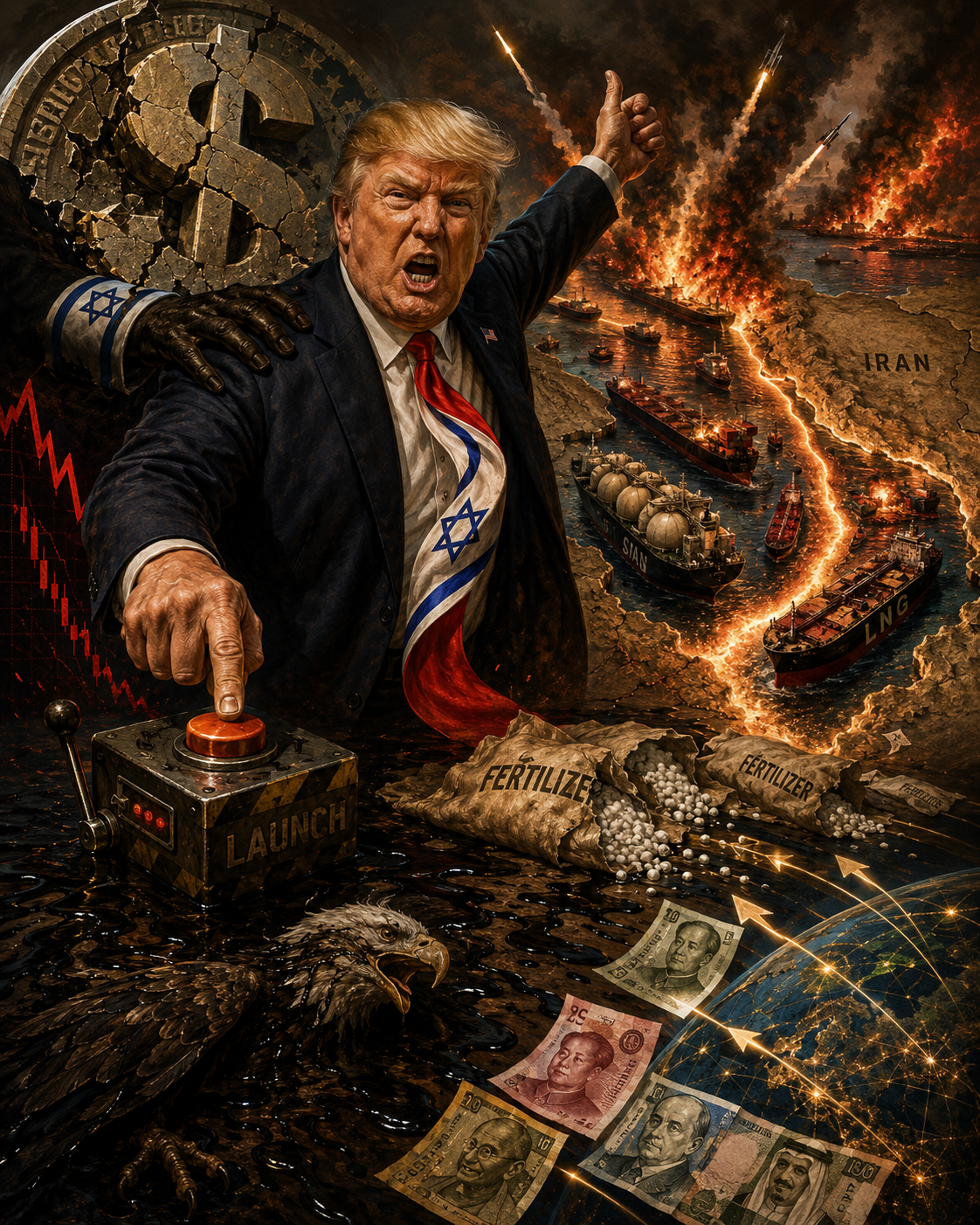
Donald Trump’s decision to attack Iran may go down in history as one of the stupidest acts of contemporary American foreign policy. Not because the United States lacks the military capacity to destroy Iranian targets. It has that capacity. The problem is something else: Trump confused destructive power with strategic intelligence. He confused military spectacle with the defense of the national interest. He confused submission to Israel with American patriotism.
The result is tragic: in trying to demonstrate strength, Trump exposed the fragility of the empire. By attacking Iran, he did not merely strike a regional adversary. He struck at the heart of a global mechanism: oil, gas, fertilizers, maritime transport, global inflation, food security, and, above all, the petrodollar system.
The Strait of Hormuz is not merely an oil passage. It is an artery of the world economy. Through it pass decisive volumes of oil, liquefied natural gas, and fertilizers. UNCTAD itself has warned that the strait carries roughly a quarter of the world’s maritime oil trade. The EIA has also noted that, in 2024, around 20% of global LNG trade passed through Hormuz, mainly from Qatar.
That changes everything. This war does not affect only the price of gasoline. It affects the cost of food. Nitrogen fertilizers, urea, ammonia, sulfur, methanol, gas, and petrochemical derivatives depend, directly or indirectly, on this route. When Hormuz trembles, supermarkets feel it. When Hormuz closes, agriculture pays. When agriculture pays, the poor go hungry.
Trump, therefore, did not merely attack Iran. He attacked global economic stability.
What is even more serious is that this decision appears less and less guided by the national interest of the United States and more and more aligned with Israel’s strategic interests. Trump sold American voters the fantasy of “America First,” but he acts as though he practices a policy of “Israel First.” He places American soldiers, American ships, American consumers, and the American economy at the service of an agenda that, in many respects, benefits Tel Aviv far more than Washington.
And here one must ask the brutal, inevitable, and politically corrosive question: does Trump do this out of geopolitical ignorance, ideological servility, or fear of some political vulnerability? There is no public proof of blackmail. But it is no longer possible to ignore the level of strategic submission. The objective fact is that Trump behaves like a president who compromises the United States in order to solve Israel’s problems.
American power rests on the dollar, on global trust, on institutional predictability, and on the belief that Washington guarantees order. By setting the Gulf on fire, Trump destroys precisely that belief.
For decades, the petrodollar system was one of the greatest wealth-transfer machines in modern history. Oil sold in dollars forced countries across the world to demand dollars. This mechanism is imperial privilege in its purest form. But that structure is already cracking. Several countries are seeking to reduce their dependence on the dollar in international transactions.
The attack on Iran accelerates this movement. Why? Because it shows the world that dependence on the dollar and on American protection is not merely a convenience: it is also a vulnerability. Trump imagined he was defending American supremacy. In practice, he gave the world yet another argument for escaping it.
American military superiority remains enormous. But modern war is not decided only on the battlefield. It is decided in logistics, currency, supply chains, energy prices, food costs, and the patience of allies. And it is precisely on these fronts that Trump’s decision proves disastrous.
The American empire has always depended on a combination of fear and trust. Fear came from its weapons. Trust came from the dollar, the markets, and the promise of stability. Trump preserves only the fear. He destroys the trust. And an empire that lives only on fear begins to die.
Trump, in the end, is sawing off the very branch on which the United States has been sitting since the 1970s. The historical irony is cruel. The president who promised to restore American greatness may be remembered as the man who accelerated its decline. Not for lack of bombs, but because of strategic stupidity. Not because he defended the United States too much, but because he confused the interests of the United States with the interests of Israel.
This war is not proof of strength. It is a symptom of decadence. And when the world discovers that it can live without asking the empire for permission, the empire has already begun to end.