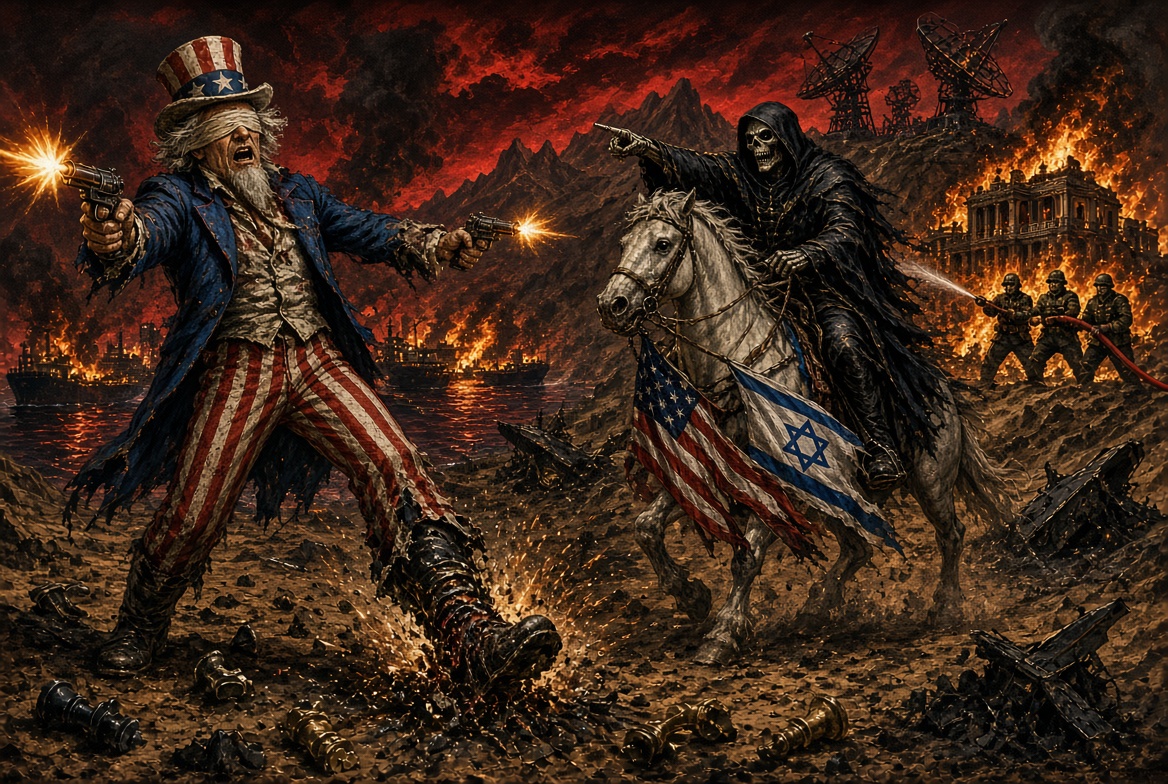
They say geopolitics is the art of playing three-dimensional chess, coldly and calculatingly anticipating the opponent's moves. They must have forgotten to tell Washington.
Under the baton of current American foreign policy, geopolitics is no longer a game of chess; it has become the exact definition of a blind man in a shootout: firing in all directions, shooting himself in the foot, and thinking he is winning the war.
The grand "master plan" for the Middle East began with a premise that would make any first-year international relations student blush. Iran, let's face it, was quiet. A country that has never attacked the United States in its history, that posed no existential threat to the West, and that, despite a closed theocratic regime, was going about its life, surviving sanctions, and minding its own business. But peace, as we know, is terrible for the arms industry's business and for the vanity of certain leaders.
That is where Benjamin Netanyahu entered the scene. Like a horseman of the apocalypse driven by an uncontrollable destructive bloodlust, the Israeli prime minister needed a war. On its own, the Israeli army — a war machine that discovered it is much easier and "safer" to massacre defenseless and unarmed children, women, and men in Gaza or Lebanon than to face a moderately equipped conventional army — cannot impose its regional will. It needed the American trigger finger. And it convinced the blind man to pull it.
The initial excuse for this madness? To bring "democracy" to Iran. The cynicism reached stratospheric levels. Talking about democratizing the Middle East with the US stamp of approval is a bad joke, especially when America's biggest and most pampered partner in the region is Saudi Arabia — an absolute monarchy where the word "democracy" is treated as contraband.
Washington's golden rule has never been so blatantly exposed: if you are subservient, lay your country's interests at Uncle Sam's feet, and crush your own people, you are a "democratic ally," no matter how bloodthirsty your government is. This explains the absurdity of Syria, where rulers who until yesterday were labeled as terrorists are today welcomed with pats on the back simply because they now defend Washington's interests. But if you do not bow down, keep your spine straight, and refuse to kneel, then any lame excuse is cooked up to demonize and bomb you.
As the initial narrative of "regime change" began to smell of failure and blatant illegality under international law, the objectives shifted with the agility of a politician in an election year. Now, according to Trump himself, the goal is to "end the Iranian nuclear program." A stroke of genius, considering that the best global analysts, including American intelligence services themselves, categorically stated that Khamenei's Iran neither had nor wanted a nuclear bomb before taking the first bombs to the head.
But the cherry on this cake of absurdities came last: the mission is now to "reopen the Strait of Hormuz." Yes, you read that right. The strait that was wide open, unobstructed, and working perfectly for global trade right up until the exact moment the US decided, out of nowhere, to start a senseless war in the region. It is the classic tactic of setting the house on fire only to sell yourself later as the hero bringing the fire hose.
The bottom line is a strategic disaster of epic proportions. Trump doesn't have the slightest idea what he is doing. He attacked Iran, a country of continental dimensions, mountainous and nationalistic, and he cannot defeat it. The bill has arrived, and it came with exorbitant interest: massive losses for the US. Fried radars, downed planes, bases turned into smoking craters.
The great irony, however, lies not on the battlefield, but on the global chessboard. With this "brilliant" attack, the United States not only violated international law but completely lost its influence in the Middle East. The family dictators and subservient monarchs, those who have always kissed the American ring in exchange for protection, are watching this spectacle of incompetence and thinking: "If this is what happens to the empire when it throws a tantrum and miscalculates everything, maybe tying our destiny unconditionally to them isn't such a good idea."
In the end, the blind man in the shootout ran out of gunpowder, shot himself in the foot, and, to top it off, convinced the entire neighborhood that he is the real public menace. A masterpiece.